Increase Throughput and Earn Money with Your Floor
Wednesday, December 30, 2009By: David Fudala
Click here if you are continuing from the print article in the January 2010 issue of Network
In today’s warehousing and fulfillment center industries, facility owners and operations managers are consistently raising their expectations of quality and looking for the latest and greatest gizmos and gadgets to help them increase pallet moves and save money on maintenance costs. What many do not realize is they already possess one of the most important components of savings; however, it most likely needs a little tweaking - I am referring to their concrete floors. Warehouse and distribution center floors should be held to rigorous Flatness and Levelness standards when it comes to their design and construction. A safe environment is especially important for workers and at the same time, a Flat and Level floor is imperative for the safe and efficient operation of MHE (material handling equipment) and AGV (automated guided vehicles).
So what constitutes Flat and Level you ask? Are you ready for an education on Floor Flatness and Levelness? This can be very confusing to many so stick with me and if you’re not into technical details please skip to “The Facts” and “New Trends” sections of the article . First of all, every concrete slab has a particular end use so it should be properly designed and constructed for that use. In addition, each slab has two distinct characteristics. One is Flatness and the other is Levelness. They are both equally important, but are two totally different components. There are two related test methods for measuring floor profiles that are acknowledged by ACI (American Concrete Institute) and ASTM (American Society of Testing and Materials). However, each method is for a different type of floor. For each system a higher number indicates a better floor. The first test method is known as Defined-Traffic floor profiling (F-min) and it’s been around since the 70’s. The traditional name for this type of floor is ‘Superflat’. This type of testing is limited to fixed MHE or AGV paths that are usually wire, rail or telemetry guided. The second test method is known as Random-Traffic floor profiling (FF/FL) and it’s been around since the 80’s. FF/FL testing is for every other concrete slab other than F-min. The FF/FL system is used to measure random open areas such as loading docks, turn-a-round areas and speed aisles, mezzanines and wide aisles where lift truck traffic is not on a fixed path. It is also used on any other concrete surface whether it is slab-on-grade or elevated decks for retail shops and malls, office buildings, educational institutions and multi-level building such as hospitals and condos. Each type listed has a unique set of parameters and specifications.
Defined Traffic aka: F-min or Superflat Floor
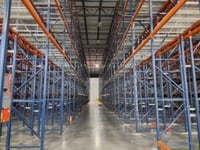
Regarding VNA warehouse storage facilities, I will now make clear Defined-Traffic testing or F-min profiling. The distinctive machine for F-min profiling is known as a dual-axis differential profileograph or ‘profileograph’ for short. It is not to be confused with a ‘California Profileograph’ which is used for measuring similar but different profiles on bridge decks, roads and highways. Its tolerances are presented as IRI (international roughness indices). The F-min profileograph has an adjustable wheelbase (frame work) that allows for adjustments to emulate a forklift’s exact wheel path that will travel within VNA (very narrow aisles). The F-min profiler machine can see and record the concrete ‘F-min floor profiles’ exactly how the actual lift truck will ride on the floor, enabling the operator to locate anomalies for correction. Here is the confusing part. F-min is broken down into to four separate tolerances and here I will discuss two that are perpendicular to one another; but, all four occur simultaneously. F-min L and F-min T represents the Minimum allowable F-number for L (Longitudinal) or front-to-back wheelbase dimension and tolerance of a lift truck; and, T (Transverse) or side-to-side load wheel dimension and tolerance of a lift truck. Both of theses profiles relate to Levelness. And these profiles are not indicative of the actual surface profile of the floor as presented by FF/FL profiles; hence, what they emulate is the left-to-right motion of the lift truck and the front-to-back motion of the lift truck simultaneously. It cannot be the profile of the floor because it is made up of elevations that are touching th
e floor in three or four points (number of wheels on MHE) at a given location all together. Each location will have a different elevation between all points at a fixed distance. When the load wheels are in the front, the angle of the lifts chassis to the rear wheel(s) will create a different elevation than when the rear wheels are at this front location because from this location (now rear - previously front) the front wheels are now on a different part of the floor which is the permanent dimension (length) forward from the rear wheels or (L) Longitudinal dimension of the lift truck, which creates yet a different elevation. So in summation, F-min is made up of what a lift truck sees with regards to wherever its wheels touch the floor at any and every location along a fixed path. Different lift truck models with different wheelbase configurations would see the floor in a different way at the same location (distance down an aisle). The profiles produced by the profileograph would appear different for each dissimilar lift as well because the wheelbase dimensions are in fact different. Up until now all I have covered is Levelness. Confused? Don’t be. The next one is easy.
Are you now wondering about the remaining two of the four tolerances? Sure you are. Okay, here they are anyway. F-min Flatness is simply the rate-of-change over a fixed distance of 12-inches. The L has a rate of change; that’s three, and the T has the same which makes four. The industry term for this component is known as ‘slope defect’. What this indicates is that for a specified F-min tolerance the rate of change calculated by the math cannot be violated. So as an example, F-min 100 slope-defect cannot exceed 0.040-inch within a 12-inch distance and that holds true for both L and T. By the way that’s (forty thousandths) of an inch or about the thinness of a compact disc. Yes, floors that flat and flatter are installed everyday and the MHE and their owners love them! There’s even an awards committee that gives a Golden Trowel to the best contractor in 13 different categories every year at the World of Concrete in Las Vegas! No, I am not messing with you, I’m serious.
There’s one more component of F-min I want you to understand and it is most important. It refers back to the L and T in the third paragraph above. When F-min is specified, and again I’ll use F-min 100 for an example, it is used in conjunction with the actual dimension of the lift trucks wheelbase. So let’s imagine you have a swing reach truck that has a maximum height of 51 feet and let’s say the Longitudinal dimension of your truck is 85-inches and the Transverse dimension of the Truck is 55-inches. When the formulas crunch the numbers of F-min, L and T, the tolerances come out as plus or minus 0.103-inches for L and plus or minus 0.080-inches for T. If you change the F-min value, the L or T value, the tolerances change respectively. Tolerance bands appear as four horizontal lines, two for L and two for T, on a graph (see charts) from plus and minus zero. These are the upper and lower limits that your lift trucks ‘static lean’ cannot exceed or it will violate F-min 100. Keep in mind a profileograph measures ‘static lean’ and when the actual lift rides on the floor it sees ‘dynamic lean’. Coupled with inertia and flexing steel, the dynamic lean can be three to four time the static lean. Simply stated, with the numbers above T equals 0.9-inches of static lean and 2.7 to 3.6 inches of dynamic lean and L equals 1.2-inches of static lean and 3.4 to 4.6 inches of dynamic lean. So if you have about that much clearance or less on each side of your carriage or load, man you’ve got a big problem especially at 9.5 ft/sec.
These two motions together can create oscillations that cause problems as well particularly with a loaded collector at the top. Anywhere the profiles are over their respective ‘tolerance band’ the floor would need to be repaired at those locations were indicated by the system. The Longitudinal profile and its horizontal limit lines (tolerance bands) are red and the Transverse profile and its horizontal limit lines are blue. Okay, that’s it! Now you have all there is to know about how F-min operates. So go out and get yourself a Superflat floor and start saving money!
Random Traffic aka: FF/FL
Now I am going to explain the other measuring system for Random-Traffic areas or FF/FL. There are a few machines on the market that measure FF/FL tolerances and they do create and elevation profile of the floor that is indicative of the surface and some are much better than others. They are moved in a straight line to collect data, then plot points on that line. Connect the dots and presto! You have a profile. To sum this one up, FF/FL is made up of point-to-point elevations evenly spaced at 12-inches and analyzed along that line. Floor Flatness or FF is the difference in consecutive one-foot slopes (24-iche curvature). Floor Levelness or FL is the difference in elevation of consecutive 10-foot intervals, both along that line respectively. These measurements are randomly laid out as per ASTM E 1155 and used to generate reports that give an overall Flatness and Levelness value to individual and combined concrete pours. For an open warehouse area, the measured values should be equal to or better than a typical specification of FF 60/ FL 40. Very useful for monitoring Random-Traffic applications, but not designed for forklift emulations in VNA. Simple - right? Don’t be fooled by point-to-point elevation devices or other small rolling machines which some claim can be used to produce F-min profiles. These machines were designed specifically for FF/FL measurements. Only a dual-axis differential profileograph can truly emulate F-min for forklift traffic wheelbase configurations.
Visualize the Difference Between Levelness and Flatness
L
evelness is what the top of a mast or load ‘sees’ most (tilt or pitch) with regards to the configuration of the load wheels and the drive wheel(s) of the lift where they all touch the floor. The higher the load, the more critical it becomes. A floor must be designed and constructed so its worst anomaly cannot interfere with the lift trucks highest lift elevation. This is known as ‘dynamic lean’ or can be visualized as swaying. Imagine a load swaying slightly in one direction only to be jerked back in the other direction as the lift rolls along the floor. This is what causes unseen; or yet, unfelt wear and tear on a lift truck’s chassis’s welds and other systems overtime which can be the ultimate demise of a lift truck. I have seen many masts (twelve on one facility alone) that have been re-welded, then plate-welded, then ultimately replaced. That’s a lot of downtime and money spent which would not have been necessary if the proper floor was installed. How many lifts do you run per shift or how many DC’s does your company operate? So imagine what it does to MHE if you can see and/or feel it! A very small bump of only one one-eighth-inch is too much and enough to cause these vehicles to sway causing the lift truck to spill loads, damage products, strike racks, or possibly crash and overturn, severely injuring the operator or other personnel. With an inferior floor it is often required for a truck to reduce its speed in certain areas to avoid contact with the racks or coming off the wire. Remember, these vehicles have no suspension and a tiny bump is like a speed bump or pothole to the MHE. All lift movements are directly related to floor profile contours, which by the way, can be controlled when constructed; or, later corrected, with the prior preferred.
Flatness is the up and down motion (smoothness or bumpiness) of the floor or ride. With Flatness issues one would experience a bumpier or shuddering ride which damages other parts, such as but not limited to, bushings, bearings, shaft seals and electrical components on not only VNA lifts, but all other lift truck types as well. Floors that cause operators to constantly speed up and slow down place unnecessary stress on electric motors and relay systems and this can reduce the charge of batteries, the overall life of the batteries and charging systems, and increases the overall workload the of the battery maintenance department.
The general populous assumes that all concrete is Flat and Level and I can assure you it is not! The typical concrete floor has a deviation of plus or minus five-eights of an inch. As humans, we can tolerate walking on a floor that is sub-standard to a certain extent; but, I’m sure everyone has tripped a time or two and looked back to see nothing on the floor. Nonetheless, it is crucial for material handling vehicles such as man-up order pickers, turret stock pickers and cranes to have a flat and level floor since they operate in very narrow aisles often at heights of 35 feet or more. I recently laid eyes on an ad for a new lift truck that reaches an altitude of 65.5 feet! That would require a floor profile of F-min 125, which would equate to plus or minus the thinness of one and one-half credit card.
Facility owners and operators with the proper floors are pleased to report they do not have problems which are associated with inferiors floors; therefore, they are yielding more money in the form of not constantly paying to fix problems. Most of the maintenance costs many facilities dish out would not be necessary if only they had the proper floor. Ask any owner or manager of a warehouse or distribution center who knew they needed a Superflat floor. More than likely they will tell you they paid the contractor and a specialty floor consulting firm to do the job together; and, they will confirm the consultant mandated daily Flatness & Levelness testing along with other services such as formwork inspections and concrete slump testing for subsequent concrete placements. I have no doubt you will find all of them extremely happy with the performance of their floors with respect to safety and efficiency. And, I’m sure they will also tell you their ROI (return on investment) is priceless.
With regards to VNA storage and Defined-Traffic (F-min) projects, more often than not, I see what may be a properly written specification for a Random-Traffic (FF/FL) floor when it should be the prior. If it is caught in time before construction begins we can rewrite it and go from there. That stops the project for a few weeks, in fact it goes backwards, because in addition to the floor spec being incorrect, other items change as well i.e. the concrete mix design, rebar schedule, joint layout, formwork layout, the place and finish methods and the testing methods and equipment. Keep in mind, the above scenario usually occurs because someone finds out they need to test the floor for ‘flatness’ the day of the concrete pour - tomorrow!
The Construction Industry for Warehouses and Fulfillment Centers
For the p
ast 20 years, it’s been highly recommended by ACI for concrete floors to be tested for “F-numbers”. ACI clearly states to use a continuous recording floor profileograph for Defined-Traffic narrow-aisle warehouses and to use the FF/FL system for Random-Traffic areas. When the concrete slabs are tested on a daily schedule with these methods as they are poured, the floors in a completed facility are far less likely to have problems when compared to those that were not tested. All of the information one needs to properly build a warehouse can be found in ACI 117 “Specifications for Tolerances for Concrete Construction and Materials”, ACI 302 “Guide for Concrete Floor and Slab Construction” and ACI 360 “Design of Slabs-on-Ground”. These volumes are quite in depth; but again, there are specialty firms that have already done due diligence for you when it comes to writing your specifications and recommending a contractor.
While construction equipment and techniques for constructing a superior Flat and Level floor continue to improve, many of the standards by which contractors’ performances are judged were implemented by members of the construction testing industry many years ago. Unfortunately due to the lack of this knowledge by many developers, architects and engineers, because of a gap between the material handling and construction industries, many facilities were and still are constructed improperly for material handling applications. As a result, the facilities at hand have suffered with profit losses from reduced efficiency and increased repair costs for the equipment and floors. The floors themselves have suffered particularly at joint locations where joints should not have been installed. Wheels do most of the damage to the joints at curled and/or rocking panel locations (inadequate rebar, poor rebar placement or no dowels, i.e. load transfer mechanisms). In turn; the deteriorating joints damage the wheels, then ultimately many other vehicle systems. It is a brutal cycle that can be ongoing with epoxy fillers that only break out and need to be replaced, or the problem can be completely eliminated – you choose. Joints, or lack of joints in particular locations, are paramount when designing a slab. Joints and slabs also vary depending on the type of warehouse whether it is dry, cooler or freezer storage. As stated before, every slab has a particular end use and not all slabs are created equal when it comes to design, construction or use.
Most project construction manuals contain concrete specifications of some sort for flatness and levelness criteria, but many are outdated and/or ambiguous. It is often left to the discretion of the “in-the-dark” owner or developer to choose what should be done, big mistake, or rely on someone in the construction industry with ‘so called expertise’ to handle this for him, another big mistake. Unfortunately many general construction companies do not have the experience needed for this type of ‘high tolerance floor’. Ask for a résumé and a list of ‘Superflat’ projects that they have completed and call their references. If they have the credentials, hire them! On the contrary, there are several firms that specialize in only this type of work and there are a dozen or so of them who are top shelf. They are the ones who earn the Golden Trowel awards!
Thirty years ago, flatness testing wasn’t common knowledge although it was in its infancy. It occurred then and is quite well known today, however it is a big world and you may be learning this for the first time. Ironically today; many owners, developers, architects, engineers, contractors and testing laboratories are simply unaware of these tolerances and thus overlook this when drawing the plans for constructing a warehouse. It is an unfortunate day for the owner or new tenant when the facility opens for business and this was not known, but as stated above, there are ways to correct it. This happens more than you want to believe, so who suffers when the owner or tenant needs a flat and level floor and does not have one? Actually the answer to that question is simple - Everyone.
The floor measuring standards were originally developed for monitoring the performance of new slab construction so material handling end users would have superior floors to suit them and ultimately their equipment. Even so, engineers and specialty contractors are using these test methods for evaluating existing floor conditions and some have designed specialized grinding equipment to remediate concrete floors. From the perspective of a floor flatness professional, the trend continues to grow as more and more material handling facilities are employing these services and benefiting from the new found life from within their floors. Many have benefited from grinding without the need for building a new warehouse or enduring major down time that is associated from remove and replace methods which are basically new construction from the beginning. The choice of not grinding requires removing all products from the racks, the racks themselves and then jack hammering out the old slab and starting from scratch – much too expensive! With grinding services, there are companies who can work in one area or one aisle at a time yet allowing lift trucks to enter the area or aisle if necessary so downtime is very minimal.
Quite often we deal with finger pointing or more professionally stated – litigation cases. Who is at fault for not ensuring the floor was designed or constructed to the proper tolerances or for the proper application? More and more each year we see an increase of law suits. I could write a book on this topic alone; however, I’ll keep it simple and say the following. Just build it right the first time and avoid this dreadful chapter. If you are looking to lease and existing facility that ‘looks’ great, have the floors inspected by an independent testing firm for one of the above specifications that pertain to your application (F-min or FF/FL) and make your decision to lease based on the report. The floor may work for you and at the same time it may be slightly less than what you were told by the sales agent. This could save you a lot of money just on the rent per square foot when negotiation a deal if you approach it that way. Be educated when you want to construct a new facility or looking at possible building to lease. For new construction ask the developer, “Do you know about the tolerance criteria F-min 100 for my VNA racking? Or if you are going to lease ask the agent, “Does this floor comply with ACI standards for FF 60/ FL 40? You’ll be doing everyone a HUGE favor from the beginning and ultimately your business.
Final Words
In conclusion, this article merely addresses some of the basics for what is needed for the proper design, construction and testing of a facility that will adequately meet the rigorous needs of your throughput and MHE. There is a plethora more to know from sub grade and vapor barriers to super plasticizers and dry shake-on surface hardeners for durably and resistance wear to semi-rigid polyurea elastomeric joint fillers and armored joints.
So be smart when it comes to warehouse/forklift/floor/construction performances and educate yourself as the information is available to you. There are many ways to save money and retain earnings when the economy is good or bad, but you presently work with one of your biggest assets everyday. So take the time to become familiar with your floor and understand how its characteristics affect your MHE and ultimately your bottom line. There could be a large ROI waiting for you!
David Fudala is the founder and CEO of ALLFLAT Consulting in Carlsbad, CA. His firm provides consulting services specifically tailored to concrete slab design, place and finish procedures, floor flatness and levelness profile measurements, corrective measures for existing slabs, and expert witness testimony. Visit www.allflat.com, or telephone 760-438-5424.
View all Industry News